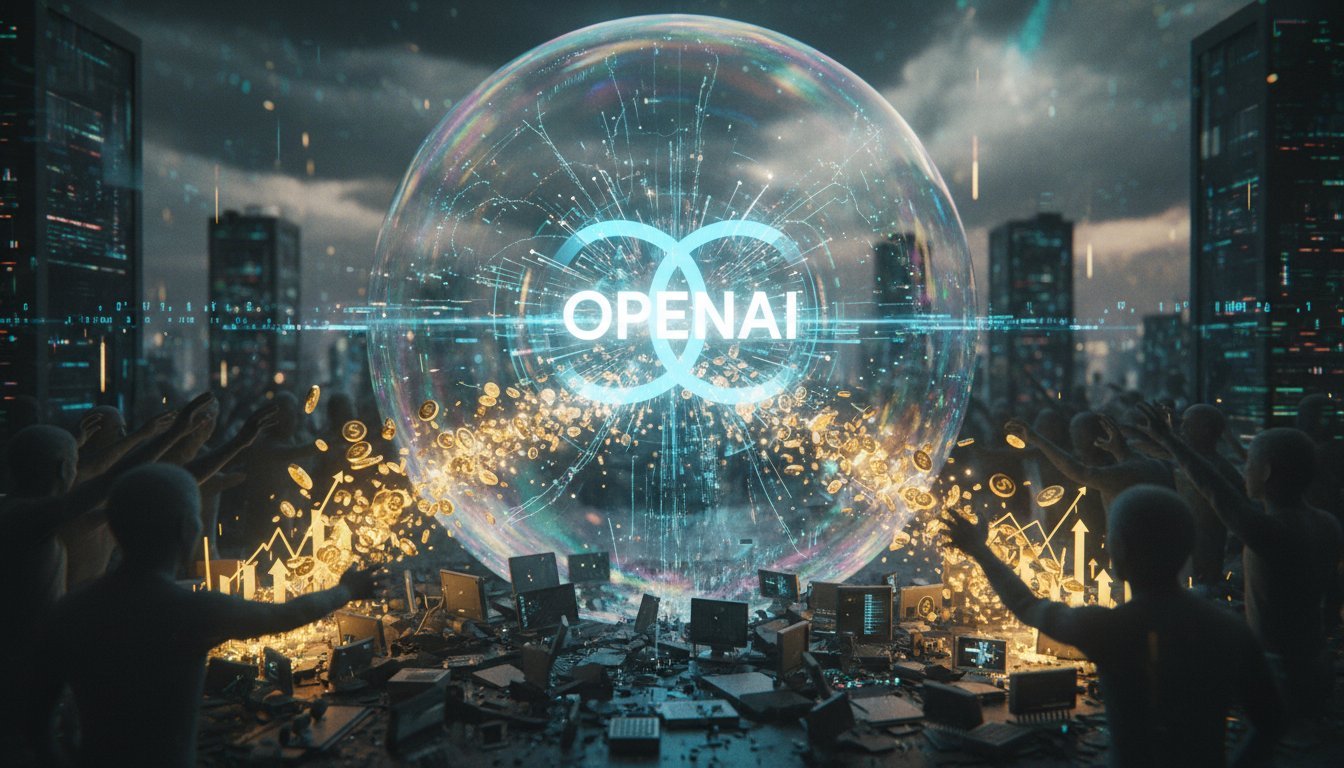
The AI Bubble: OpenAI’s Central Role in Fueling Hype and Investment Frenzy
As artificial intelligence continues to dominate headlines and investor portfolios, concerns are mounting over a potential “AI bubble” driven by unprecedented hype and speculation. At the heart of this fervor sits OpenAI, whose groundbreaking large language models (LLMs) like those powering ChatGPT have not only captivated the public but also attracted trillions in investments. However, industry leaders and market movements suggest the excitement may be unsustainable, with risks echoing the dot-com crash. This roundup examines OpenAI’s influence through expert warnings and global market reactions.
Expert Warnings: An LLM Bubble Led by OpenAI’s Dominance
Hugging Face CEO Clem Delangue recently distinguished between a broader AI revolution and a narrower “LLM bubble,” directly tying the latter to companies like OpenAI. In an interview at an Axios event, as reported by TechCrunch, Delangue argued that the outsized attention on LLMs—central to OpenAI’s advancements—could burst as early as next year. “I think we’re in an LLM bubble, and I think the LLM bubble might be bursting next year,” he said, emphasizing that LLMs are just one subset of AI applications in fields like biology and chemistry.
Delangue highlighted how the focus on massive, compute-intensive models like OpenAI’s has skewed investments, predicting a shift toward smaller, specialized models for practical uses, such as banking chatbots. Despite potential impacts on Hugging Face, he noted the AI industry’s diversification would cushion broader effects, crediting their capital-efficient approach amid peers’ billion-dollar spends.
Similarly, Google CEO Sundar Pichai issued a stark caution on AI’s “irrationality,” specifically pointing to OpenAI’s aggressive expansion. In a BBC interview covered by Ars Technica, Pichai warned that the sector’s trillion-dollar boom—exemplified by OpenAI’s $1.4 trillion infrastructure commitment over eight years against just $13 billion in expected 2023 revenue—mirrors the 1990s internet excess. “I think no company is going to be immune, including us,” Pichai stated, adding that while AI’s long-term value is profound, current overshooting could lead to painful corrections.
AI critic Ed Zitron echoed these sentiments to Ars Technica, criticizing the “excess investment” in AI leaders like OpenAI and predicting more industry figures will soon align against the hype. OpenAI’s CEO Sam Altman himself admitted at a private August dinner that investors are “overexcited,” foreshadowing significant losses for someone in the space.
Market Turmoil: Sell-Offs Signal Bubble Fears Tied to AI Speculation
The rhetoric is manifesting in real-time market jitters, with global stocks tumbling amid worries over AI valuations heavily influenced by OpenAI and peers like Nvidia. The UK’s FTSE 100 index suffered its biggest one-day drop since April, closing down 1.27% at 9,552 points—its lowest since late October—according to live coverage by The Guardian. Engineering firm Melrose fell 3.9%, while broader Asia-Pacific markets hit one-month lows, dragging down risky assets like cryptocurrencies.
Analysts attributed the sell-off to fading enthusiasm for AI-driven tech stocks, compounded by anxiety over Nvidia’s upcoming results and dimming hopes for U.S. rate cuts. AJ Bell’s Danni Hewson described the mood as “palpable nerves,” warning the FTSE could “slump back” just weeks after flirting with 10,000 points. This volatility underscores how OpenAI’s influence—through its role in the “Magnificent Seven” tech giants—amplifies speculation, with critics like Zitron arguing there’s little defense for the overinvestment compared to the internet era’s more tangible outcomes.
- Key AI Trends to Watch: Shift from monolithic LLMs to specialized models; potential burst in 2026; diversified AI applications beyond hype.
- OpenAI’s Influence: $1.4T infrastructure bet fuels bubble narrative; revenue growth lags behind expectations.
- Investment Risks: Echoes of dot-com; experts urge caution amid trillion-dollar deals.
While OpenAI’s innovations have undeniably accelerated AI trends, the convergence of expert skepticism and market corrections signals a pivotal moment. Investors and stakeholders must navigate this hype with tempered expectations to avoid a speculative implosion.